Adım Adım Amasya

Water and Healing Route · Stop 8

Kunç Bridge

Seljuk dressed stone, three great piers. And the very spot where Amasya's best-known story takes place.

Seljuk period Dressed stone Şamlar neighbourhood
Kunç (Kuş) Bridge
Kunç Bridge. Hüseyin Menç Archive (Kültürel Miras Boyutuyla Amasya, Photo 27).

📜 What do the documents say?

Linking the Bayezid Paşa and Şamlar neighbourhoods, the bridge stands in front of the Şamlılar neighbourhood, opposite the Kumacık Bathhouse.

It bears the typical features of Seljuk architecture and is built entirely of dressed stone. Architecturally, it stands out for its wide arched spans resting on three great piers. Locally it is also known as the “Kuş Köprü” (the Bird Bridge).1

Strabo's bridge? According to Ülkü Duman, one of the two bridges Strabo mentions is today's Alçak Köprü; the second, which linked the suburbs to the outside, must have stood on or near the site of today's Kunç Bridge.2

A Lokman in the documents. The first physician of the Amasya Darüşşifa was also called Lokman: Reşideddin Lokman bin Hasan el-Harezmî.3 We tell how this name is tied to the legend on the Museums page.

It was repaired in 1938, and its deck was paved with stone setts.1 So the surface you walk on today is not the bridge's original one.

🗣️ What do the people say?

According to the story, Lokman Hekim — Lokman the Physician — had found a cure for death. Through knowledge he received from Şahmeran, the eye of his heart had been opened: wherever he went, flowers would speak and tell him which ailment each of them could cure. In the end he found the remedy for death itself.

“When he found the cure for death, Gabriel, peace be upon him, comes. ‘O Lokman!’ he says, ‘let me look at what you’re holding.’ ‘No, I won’t let you look,’ he says, ‘I’ve found the cure for death,’ he says. ‘You found it’ — ‘you didn’t’ — and the two of them come to grips. They were on the bridge, so it is said.

Can Lokman Hekim stand up to Gabriel, peace be upon him? The moment he strikes, more than half of what he is holding spills out. Only a single sheet of paper is left.

Gabriel, peace be upon him, goes before God Almighty. ‘Don’t touch Lokman,’ he says. ‘He is a very great saint, a blessed one,’ he says.”

Read the original Turkish, as it was told

“Ölüme çare bulunca Cebrail aleyhisselam geliyo. ‘Ya Lokman!' diyo, ‘Elindekilere bakayım.' ‘Yok, baktırmam.' diyor, ‘ölüme çare buldum.' diyor. Bulduydun, bulamadıydın diye bunlar kapışıyorlar. Köprüdeymişler.

Lokman Hekim Cebrail aleyhisselamla çıkışabilir mi? Nasıl vurunca elindekilerin yarısından fazlası dökülüyo. Sadece bir kâğıt kalıyo.

Cebrail aleyhisselam Cenab-ı Allahü Teâlâ'nın yanına gidiyor. ‘Lokman'a ellemeyin' diyor. ‘O çok büyük bir evliya, mübarek.' diyor.”

From Tuğrul Balaban's collection, as it was told (the first variant); English translation ours. Informant: Hamdi Keklikçi (b. 1946), Amasya; he heard it from his elders.4

One more variant: healing barley. In the Amasya variant given by the Yurt Ansiklopedisi, Lokman has gathered the cures for all illnesses and for death in a book. As he crosses the Kunç Bridge, Cebrail (Gabriel) comes, strikes the book, and the page on which the cure for death was written falls into the water. That is why the barley fields watered by this river are considered healing, and barley water used to be drunk as a cure.5

This section is a folk narrative, not a document. The collection records two variants; in both, the encounter takes place on the Künç Bridge and the secret of immortality falls into the Yeşilırmak.4 The Yurt Ansiklopedisi also writes that the legend is said to come from Çukurova, where the paper flies from Lokman's hand as he crosses the Misis Bridge over the Ceyhan river.5 So what is Amasya's own is the tying of the story to the Kunç Bridge. In 1936 the legend was also the subject of Süheyl Ünver's article “Amasya ve Civarında Lokman Hekim Efsanesi ve Bazı Tıbbi İtikatlar”.4
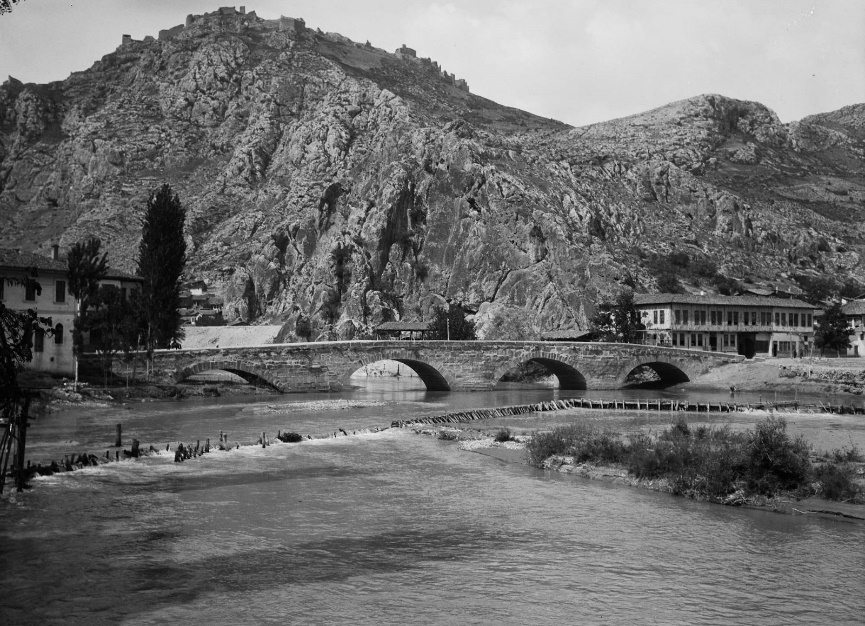
Look at the bridge's piers

The second variant of the story (informant Varol Bulut, b. 1990, Amasya city centre) ends like this:

“It is still there —on the piers of the Künç bridge and in the grass along its edge, in the heaps of earth— there is grass that grows green summer and winter.”4 “Hala orada —Künç köprünün hem ayaklarında hem de kenarındaki otlarda, toprak birikintilerinde— yaz kış yeşil biten otlar vardır.”

Now lean over and look. Is the grass there? What season is it? The story is showing you something — whether you look is up to you.

👁️ What did the witnesses see?

1927-1930 · Albert Gabriel. The French architect and art historian who came to study Amasya's monuments first notices a gap: Evliya Çelebi never mentions this bridge. Ask the townspeople and the bridge is Seljuk. Gabriel looks at the foundations instead: But in our examination of its foundations we saw clearly, and understood, that it was built on the foundations of an old bridge made in antiquity. In his view, this may well have been the bridge that, as Strabo describes, linked the city to its suburbs and the countryside.6

Gabriel's words are given from the Turkish translation in Ali Tuzcu's compilation; the English is ours.

Who had the bridge built?

The sources give different accounts. This page does not take sides.1, 7

Hüseyin Hüsameddin

The bridge was commissioned by Hundi Hatun, daughter of the Seljuk Sultan Mesud II. Over time its name, too, developed from hers.7

Another view

The bridge was either repaired by Yörgüç Paşa or built by Bayezid Paşa using stones from the Ayvasıl Monastery.7

According to Hüseyin Hüsameddin, the name changed like this:1, 7

Hundi→ Kundi→ Kunç

Near the bridge: Dersi Tamam

Near the Kuş Köprü there is a small tomb. It takes its name from a lesson left unfinished.

📜 What do the documents say?

In the tomb lies Müftüzade Hacı Ömer Efendi. According to Edip Uzundal he served as mufti in the 1700s; he won people's affection by his way of life and his good character, and was known among the people as “Dersitamam” (“the lesson is complete”). When he died in 1723 he was buried in the cemetery near the Kuş Köprü; those who loved him surrounded his grave with a single-celled, open-roofed tomb.8

🗣️ What do the people say?

According to a narrative recorded in Amasya, when the holy Dersitamam died, his students' lessons were left unfinished. So he completes those lessons after his death, at his own graveside. That's why his name is Dersitamam.4

The same teller adds that when the municipality tried to remove the grave, which had ended up in the middle of the road, the tip of the bulldozer broke. After that they fenced the place round. They never touched it again.4

This section is a folk narrative, not a document; the bulldozer story is a memorate, an event its teller believes really happened.

While you are there, look for

Key facts

Period
Seljuk
Commissioned by
Disputed — see above1, 7
Other name
Kuş Köprü (the Bird Bridge)1
Structure
Entirely dressed stone; three great piers, wide arched spans1
Repair
1938 — deck paved with stone setts1
Location
40.657934, 35.835408 — verified against OpenStreetMap
In the book
Kültürel Miras Boyutuyla Amasya, p. 59

📍 Open on the map 🚶 Walking route (Google) 🚶 Walking route (Yandex)

Sources

Every factual statement on this page rests on one of the sources below. Titles are given in their original Turkish so that they can be found; quotations from them are our translations.

  1. Fuat Er, XV. ve XVI. Yüzyılda Amasya (Elazığ: Sosyal Bilimler Enstitüsü, Yüksek Lisans Tezi, 2009), 39-40.
  2. Ülkü Duman, Anadolu Selçukluları Devrinde Amasya Şehri (Niğde: Niğde Üniversitesi Sosyal Bilimler Enstitüsü, Yüksek Lisans Tezi, 2010), 10.
  3. Kevser Çobanoğlu, Anadolu Selçuklu Dönemi Amasya Medreseleri (Sivas: Sivas Cumhuriyet Üniversitesi Sosyal Bilimler Enstitüsü, Yüksek Lisans Tezi, 2019), 43.
  4. Tuğrul Balaban, Amasya Efsane, Menkabe ve Memoratları (Amasya: Amasya Valiliği, 2014), 17, 93-94, 555-557, 605, 724, 728. — “Lokman Hekim (I)” (informant Hamdi Keklikçi, b. 1946) and “Lokman Hekim (II)” (informant Varol Bulut, b. 1990, Amasya-Merkez); that these years are years of birth comes from the “Kaynak Kişiler” (informants) list at the end of the book. According to the motif summary on pages 93-94, in both variants the secret of immortality falls into the Yeşilırmak. Narrative 160, “Dersitamam” (informant Muhammet Duran, b. 1956, Amasya): 605. Süheyl Ünver's article of 1936 is listed in Balaban's bibliography: 17.
  5. “Amasya”, Türkiye İl İl: Dünü, Bugünü, Yarını — Yurt Ansiklopedisi, C. 1 (İstanbul: Anadolu Yayıncılık, 1982), 490. — The section “Söylenceler” (legends): the Çukurova (Misis Bridge) and Amasya (Kunç Bridge) forms of the Lokman Hekim legend.
  6. Ali Tuzcu, Seyahatnâmelerde Amasya (Amasya: Amasya Belediyesi Kültür Yayınları, 2007), 342-343, 353. — The introduction to Albert Gabriel and his Amasya work of 1927-1930 (342-343); his observation on the foundations of the Kuş Köprü (353).
  7. Abdizade Hüseyin Hüsameddin Yasar, Amasya Tarihi 1-4 (Amasya: Amasya Belediyesi Kültür Yayınları, 2022), 104.
  8. Edip Uzundal, Sultan II. Abdülhamid Dönemi'nde Amasya Sancağı (Sosyal, Ekonomik, İdarî ve Demografik Yapı) (Tokat: Gaziosmanpaşa Üniversitesi Sosyal Bilimler Enstitüsü, Doktora Tezi, 2017), 179. — “Dersi Tamam Türbesi”.

Continue the route

Water and Healing · stop 8 of 11