We know who had this bathhouse built. But what we really know is who ran it a
hundred years ago, who stoked its furnace and who sat in the coffee house next door.
15th centuryYörgüç Paşazade Mustafa BeyIn front of the Bimarhane
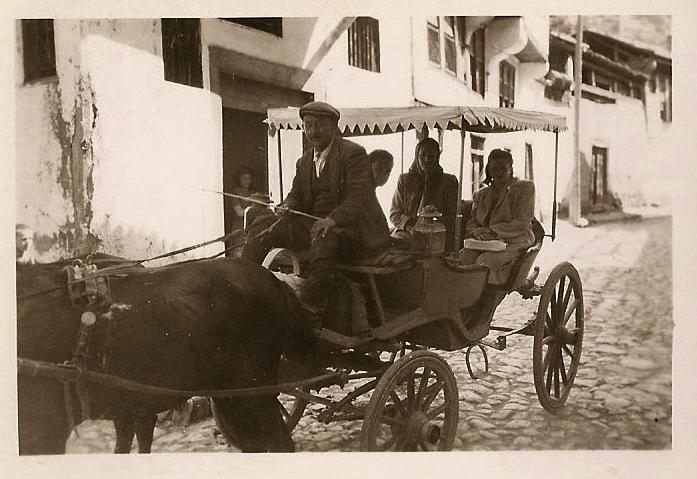
“Going to the hamam.” Bundles and copper bowls in the canopied cart.
The hamam was not just a building; it was a whole day.
Hüseyin Menç Archive.
📜 What do the documents say?
The bathhouse is in the Mustafa Paşa neighbourhood, on the south side of the
Mehmed Paşa Mosque.
The building repeats the classic Ottoman bathhouse design.1
It takes its name from its founder: because it was first built by Yörgüç
Paşazade Mustafa Bey, it is known as the “Mustafa Bey Hamamı”.1
It was badly affected by the earthquakes so frequent in Amasya and fell into
ruin. In 1830 it underwent a major repair and was opened again.1
Which year?
The sources agree on the founder; on the year they differ by one.
This page takes no side.
1436
The date given on the basis of Pars Tuğlacı's Osmanlı Şehirleri: the
bathhouse was built in 1436 by Yörgüç Paşazade Mustafa Bey.1
1437
Kani Kuzucular, listing the standing buildings by period, records the Mustafa
Bey Bathhouse as built in 1437.2
Who ran this place a hundred years ago?
Osman Fevzi Olcay of Amasya describes this bathhouse as well when he writes
about the Sofu-zade neighbourhood, where he was born and grew up. What he tells is
not a document but a memoir; yet no other source shows the daily life of a
bathhouse so closely.3
“Karabaracıoğlu Hacı Ali Hafız Ağa, the bathhouse keeper: he was a
charitable, generous, neighbourly, very clean and noble-hearted man.
Hacı Hafız Ağa ran the Sinan Bathhouse at Selağzı and the Mustafa Bey
Bathhouse in front of the Bimarhane. Both of these bathhouses were under Hafız
Ağa's management, and the women's section was run by his wife, Ayşe Hanım.
In the evening, once the bathhouse had closed, the attendants of both bathhouses
would stoke the furnace on the night watch, as its state required.”
Osman Fevzi Olcay, Amasya Hatıraları.3
Olcay also sketches the childhood geography of the neighbourhood: the open ground
in front of the Bimarhane, the Mustafa Bey Bathhouse and the Çevikçe School was
their “main playground”. On the corner directly opposite the bathhouse
stood the house of Mumcu Hakkı (Hakkı the candle-maker).3
“Between the Mustafa Bey Bathhouse and the furnace part of the bathhouse
there was a raised coffee house. In the evenings we would go up to this coffee
house now and then.
The regulars of the coffee house were mostly fanciers of Indian hens and Indian
cocks, and hunters. They would gather in this coffee house every night without
fail, and on some nights they would even bring their cocks and set them fighting
each other.”
Osman Fevzi Olcay, Amasya Hatıraları.3
Look for the furnace
The least visible but hardest-working part of a bathhouse is the furnace
(külhan) — the firing place where the water is heated. According to Olcay,
this one's furnace was stoked on a night watch, as its state required:3
that is, someone sat by the fire all night.
Walk round to the back of the building. The furnace side is usually the low,
soot-stained part, away from the street; the fuel goes in there. The “raised
coffee house” that Olcay climbed up to as a child stood between the bathhouse
and the furnace.3
The coffee house has gone, and so have the cocks. But that gap between the
bathhouse and the furnace is still there.
How many bathhouses were there in Amasya?
According to the yearbooks (salname) of the province of Sivas, the number of
bathhouses in Amasya, the seat of the sancak, ran as follows:1
Yearbook
Bathhouses
1875
19
1876
22
1880
19
1882
14
1883
14
1888
14
In 1903 and 1907, 130 inns and 54 bathhouses were recorded across the whole
sancak of Amasya.1
The four bathhouses on this route are what is left of that number.
Ottoman bathhouses were also told apart by type: those with separate sections for
women and men were called “çifte hamam” (double bathhouse), those in
the neighbourhoods set aside for women alone “avret”, and those built
for men in the bazaar “rical hamamı”.1
👁️ What did the witnesses see?
1645 · Evliya Çelebi. Listing the bathhouses of Amasya, Evliya also gives the
place of this one: near Bayezid Paşa, adjoining the Mehmed Paşa mosque, the Mustafa
Bey Bathhouse. In the same list he names Kumacık, an
“Alaca Çardaklı Hamam” (bathhouse with the many-coloured pavilion) on the water's edge
at the head of the Alçak Köprü, and four bathhouses inside the castle.4
Evliya's words are given from the Turkish translation in Ali Tuzcu's compilation; the English is ours.
They asked the mufti: may one eat pickles in the bathhouse?
Among the Amasya fetvas (legal opinions) collected by Mustafa Vâzıh Efendi there
is a question about the bathhouse: some ladies, on their way to the bathhouse, take
pickles, fruit and other appetising things with them and nibble them in a corner of the
bathhouse. Poor children watching from a distance long for them; and the crumbs get
into the dirty water, which is disrespectful to bread. Should this be stopped through
the wives of those who run the bathhouse?
The answer: It should. The mufti adds a note: in this way those who run the
bathhouse earn merit, and save those they stop from sin.5 The “wives of those
who run the bathhouse” of the fetva appear in Olcay's memoirs too: the women's
section of this bathhouse was managed by the operator's wife, Ayşe Hanım.3
When the river came to the door
The people of Amasya used to say of the Yeşilırmak: its flowing is a blessing, its
swelling a delight, its overflowing abundance.6 But sometimes the river
brought more than abundance. On 3–6 April 1940, after rains “like the
Flood”, the Sultan Bayezid II Complex, the Hacı İlyas
neighbourhood, the area around the Government House and Ziya Paşa Boulevard went under
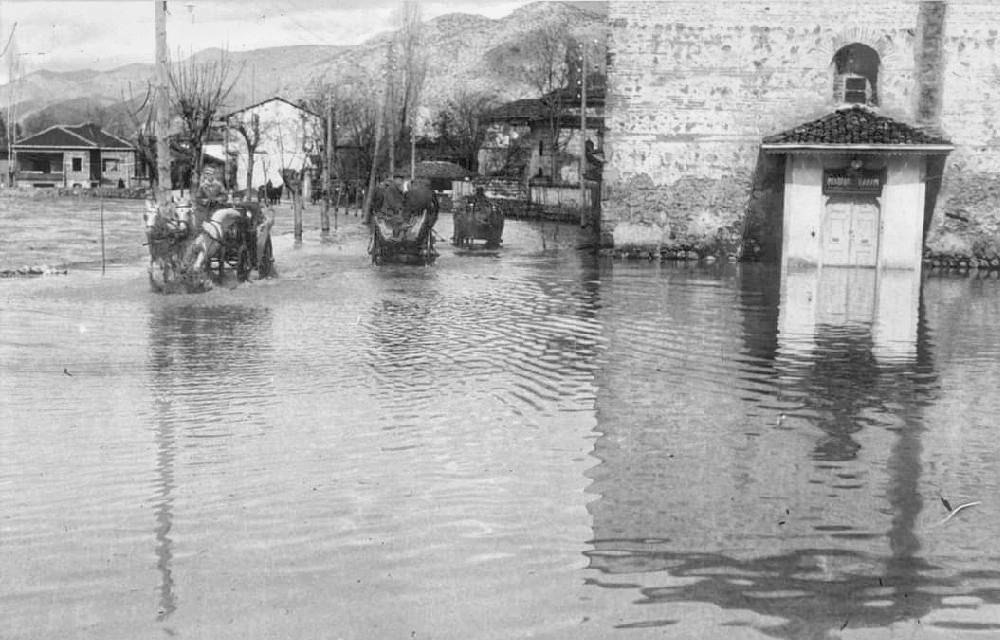
water, and so did the Mustafa Bey Bathhouse. People trapped by the water were
rescued with boats brought from Samsun.6
The Mustafa Bey Bathhouse during a flood of the Yeşilırmak. The square in front
of it is under water; horse-drawn carts are wading through. In front of the door stands
a whitewashed, tile-roofed entrance kiosk; higher up there is a small arched window.
The date of the photograph is not certain. The copy in the archive was coloured later;
it is shown here in black and white.
Hüseyin Menç Archive.
While you are there, look for
In front of the door and above it. In the flood photograph there is a
whitewashed entrance kiosk in front of the door and a small arched window higher up.
Which of them is still there today?
The furnace side. The back of the building, the low and soot-stained
part.3
The “elephant's eyes” in the domes. These openings above the hot
room let light fall into the steamy air.
North, to the Mehmed Paşa Mosque. The bathhouse is to its south;1
the open ground between the two was Olcay's childhood playground.3
East, to the Bimarhane. When Olcay describes this
bathhouse, this is the address he gives: “the Mustafa Bey Bathhouse in front
of the Bimarhane.”3
The courses of stone. The building underwent a major repair in
1830;1 differences of period can be read in the wall.
Key facts
Period
15th century — 1436 or 14371, 2
Commissioned by
Yörgüç Paşazade Mustafa Bey1
Neighbourhood
Mustafa Paşa neighbourhood; south of the Mehmed Paşa Mosque1
Architecture
Classic Ottoman bathhouse plan1
Repair
1830 — major repair, reopened1
Location
40.654253, 35.835631 — verified against OpenStreetMap
Every factual statement on this page rests on one of the sources below.
Titles are given in their original Turkish so that they can be found;
quotations from them are our translations.
Edip Uzundal, Sultan II. Abdülhamid Dönemi'nde Amasya Sancağı (Sosyal, Ekonomik, İdarî ve Demografik Yapı) (Tokat: Gaziosmanpaşa Üniversitesi Sosyal Bilimler Enstitüsü, Doktora Tezi, 2017), 183-186.
Kani Kuzucular, Amasya Kenti'nin Fiziksel Yapısının Tarihsel Gelişimi (İstanbul: İstanbul Teknik Üniversitesi Fen Bilimleri Enstitüsü, Doktora Tezi, 1994), 69.
Osman Fevzi Olcay, Amasya Hatıraları (Bildiklerim, Gördüklerim, İşittiklerim) (Amasya: Amasya Belediyesi, 2009), 30-35. — The section “Sofu-zade Mahallesi”, pp. 30-35.
Ali Tuzcu, Seyahatnâmelerde Amasya (Amasya: Amasya Belediyesi Kültür Yayınları, 2007), 64, 70. — Evliya Çelebi's visit of 1645 (64) and his list of the bathhouses of Amasya (70).
Mustafa Vâzıh Efendi, Amasya Fetvâları ve İlk Amasya Şehir Tarihi (Belâbilü'r-Râsiye fî Riyâz-ı Mesâili'l-Amâsiyye), haz. Ali Rıza Ayar – Recep Orhan Özel (Amasya: Amasya Belediyesi Kültür Yayınları, 2. Basım, 2011), 17. — Question 10, on ladies nibbling food in the bathhouse.
Eren Şenol, Amasya'nın Cumhuriyet Dönemi Kentsel Gelişim Süreci ve Kentleşme Sorunları (Ankara: Ankara Üniversitesi Sosyal Bilimler Enstitüsü, Doktora Tezi, 2010), 199, 201. — The saying about the Yeşilırmak (199; after Abdizade) and the flood of 3-6 April 1940 in Table 65 (201; after Amasya Belediyesi 2007).
Note: the “Going to the hamam” picture at the top of this page is not of this bathhouse; it shows people going to the hamam in Amasya. The bathhouse itself is in the flood photograph above. The present state of the building awaits confirmation on site; the coordinates have been verified.