This building's name comes from a colour, and its
entrance is found in no other mosque in
Anatolia. You can see both at its door.
1266–1267Seyfeddin TorumtaySeljuk
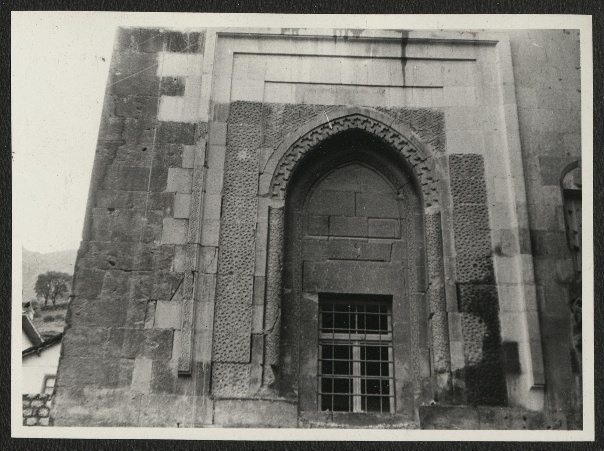
The iwan-shaped entrance. A deep, pointed-arched niche; carved stone borders
at its edges, relief stone panels on either side. According to the sources, this is
the only mosque in Anatolia with an iwan-shaped entrance.1TTK Archive (Kültürel Miras Boyutuyla Amasya, Photo 6).
📜 What do the documents say?
The building is thought to have been built in 1266-1267 by Seyfeddin
Torumtay (Turumtay), governor of Amasya.2
Its name has two sources: the tomb adjoining the mosque was decorated with
purple-turquoise tiles and glazed bricks, and the entrance part of the
building was used as a madrasa.3
It is the only mosque in Anatolia with an iwan-shaped entrance, and it has a
plan of three aisles running perpendicular to the qibla wall.1
What does “the only mosque with an iwan entrance” mean?
In Anatolia, the only mosque with an iwan-shaped entrance.
The source says so plainly.1
An iwan is a vaulted space closed on three sides and entirely open on one.
Iwans are the great niches facing onto the courtyards of madrasas and caravanserais;
they are a signature of Iranian and Seljuk architecture. In mosques, however,
the entrance is usually a portal — an ornate doorway opened in a wall.
Here, though, the entrance itself is an iwan: the door is not set in a flat
plane but inside a deep hollow. You can see it in the photograph above — the
arch is not on the surface of the wall but at the mouth of a volume drawn back
inwards. This is the language of the madrasa carried over into a mosque —
and indeed the entrance part of the building was used as a madrasa.3
But what kind of madrasa? Some researchers suggest that the building was
used as an observatory, a “madrasa of the sciences of the
sky”. Çobanoğlu disagrees: the madrasa's first teacher was a
physician, and the building lacks what buildings used as observatories should
have — a dome open to the sky with an observation well beneath
it.3
Why “Gök”?
In Turkish, “gök” (sky) is also a colour — the blue of the
sky. The building's name comes from the purple-turquoise tiles and glazed
bricks that covered the tomb next to it.3
cobalt
turquoise
purple
gök
The strip above is representative — these are not measured colour values of
the tiles on the building. The source says only “purple
turquoise”.3
Other names
Gökmedrese CamiiTurumtay CamiiMedrese-i Seyfiye
The second comes from its founder, the third from his name
(Seyfeddin).3
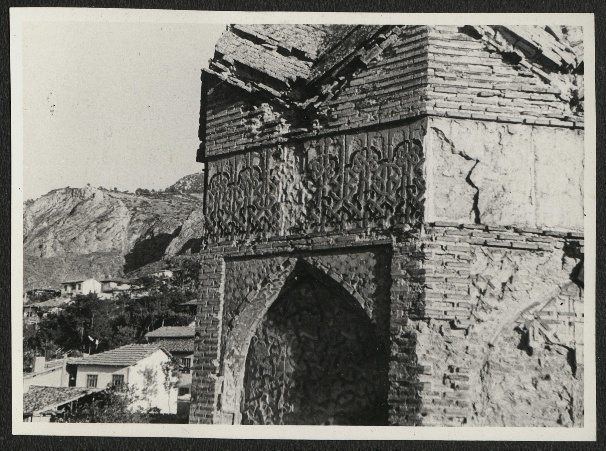
The source of the name. The band with geometric patterns beneath the
eaves — tiles and glazed brick. Below it, a pointed-arched niche with
muqarnas. When this band was in colour, it was what gave the building its
name.3TTK Archive.The iwan entrance, with its whole façade. The relief stone panels on
either side of the arch and the plain moulded band above.
The door is not on the surface of the wall — it is at the mouth of a volume drawn
back inwards.1TTK Archive.
What was said about the tomb next door?
Mustafa Vâzıh Efendi, who wrote the first city history of Amasya in the 19th
century, describes the tomb built by Torumtay Paşa like this:
Torumtay Paşa had a tomb resembling the Kaaba built.
Mustafa Vâzıh Efendi, as quoted in
Kültürel Miras Boyutuyla Amasya.4
The comparison is not idle. Most Anatolian tombs have an octagonal body and a
conical roof — pointed buildings that taper upwards. The
Halifet Gazi Tomb is like that too. The Torumtay Tomb,
by contrast, is rectangular in plan with a flat roof outside: in other words,
a cube.5 That is what Vâzıh Efendi saw.
1645 · Evliya Çelebi. He makes a short note in his list of mosques:
The Gökmedrese Mosque; its dome is leaded, and it has no minaret.6
1847 · Dr. Perunak Feruhan Bey. Two hundred years later the building is
still one of the city's foremost: The chief mosques are the Bayezid and the
Gök Medrese.6
Around 1860 · Andreas David Mordtmann. He counts the Gökmedrese and an
observatory among the most famous works of the Seljuk period; but the sight he
found was a sad one: The Gökmedrese is half in ruins, and the observatory has
collapsed.6
What came next is in the documents: for many years the building served as a
wheat store of the Soil Products Office, was a museum between
1962-1977, and was then reopened for worship.3, 7 The
travellers' words are quoted from the Turkish translations in Ali Tuzcu's
compilation; the English is ours.
Look at how deep the door is
Think of the door as you enter any other mosque in Amasya: an opening in a flat
wall, within an ornate frame. Then come here.
Here, before you reach the door, you enter a space. Vaulted above you, closed
on both sides, open in front. This is the iwan — and in Anatolia there is no
other mosque whose entrance is built like this.1
Then look up: look for tiles and glazed brick in the band beneath the eaves.
That is where the building's name comes from.3 How many colours can you
count?
While you are there, look for
The depth of the entrance. An iwan — the only one in Anatolia.1
The band of tiles and glazed brick beneath the eaves. The source of the
name.3
The direction of the aisles inside. Three aisles, running perpendicular
to the qibla wall.1
The tomb next door.
Not octagonal and conical — rectangular and flat-roofed.5
The nearby Halifet Gazi Tomb.
Compare: it is octagonal, with a conical roof.8
Key facts
Date
1266–1267 (thought to be)2
Commissioned by
Seyfeddin Torumtay (Turumtay), governor of Amasya2
Other names
Turumtay Camii; Medrese-i Seyfiye3
Plan
Iwan entrance; three aisles perpendicular to the qibla wall1
Why the name
The purple-turquoise tiles and glazed bricks of the adjoining tomb3
Location
40.649443, 35.820079 — verified against OpenStreetMap
Every factual statement on this page rests on one of the sources below.
Titles are given in their original Turkish so that they can be found;
quotations from them are our translations.
Ersel Oltulu, Amasya'nın Anıtsal Eserleri ve Hızır Paşa Külliyesi Restitüsyon ve Koruma Önerisi (İstanbul: Yıldız Teknik Üniversitesi Fen Bilimleri Enstitüsü, Yüksek Lisans Tezi, 2006), 26.
Zeynep Küpra Ketil, Amasya Türbeleri (Konya: Selçuk Üniversitesi Sosyal Bilimler Enstitüsü, Yüksek Lisans Tezi, 2019), 19.
Kevser Çobanoğlu, Anadolu Selçuklu Dönemi Amasya Medreseleri (Sivas: Sivas Cumhuriyet Üniversitesi Sosyal Bilimler Enstitüsü, Yüksek Lisans Tezi, 2019), 35, 37-38. — The origin of the name (35); the wheat-store and museum period (37); views on the building's function (37-38).
Mustafa Vâzıh Efendi, Amasya Fetvâları ve İlk Amasya Şehir Tarihi (Belâbilü'r-Râsiye fî Riyâz-ı Mesâili'l-Amâsiyye), haz. Ali Rıza Ayar – Recep Orhan Özel (Amasya: Amasya Belediyesi Kültür Yayınları, 2. Basım, 2011), 59.
Kani Kuzucular, Amasya Kenti'nin Fiziksel Yapısının Tarihsel Gelişimi (İstanbul: İstanbul Teknik Üniversitesi Fen Bilimleri Enstitüsü, Doktora Tezi, 1994), 41.
Ali Tuzcu, Seyahatnâmelerde Amasya (Amasya: Amasya Belediyesi Kültür Yayınları, 2007), 69, 161, 188, 194. — Evliya Çelebi (69), Dr. Perunak Feruhan Bey (161) and Andreas David Mordtmann (194; according to Tuzcu, the date of his third visit, though not certain, is 1860: 188).
Ülkü Duman, Anadolu Selçukluları Devrinde Amasya Şehri (Niğde: Niğde Üniversitesi Sosyal Bilimler Enstitüsü, Yüksek Lisans Tezi, 2010), 38.
Tolga Aydın, Amasya Tekkeleri (Bursa: Bursa Uludağ Üniversitesi Sosyal Bilimler Enstitüsü, Yüksek Lisans Tezi, 2019), 61.
The building date is not certain. The sources give the date with the proviso “it is thought”; this page does not present it as certain either.