📜 What do the documents say?
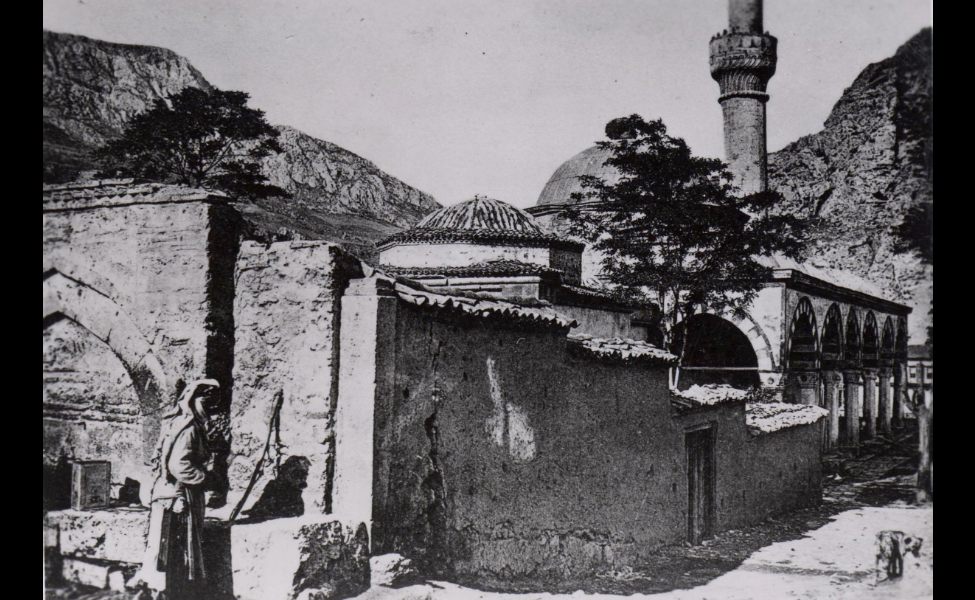
The mosque stands on the bank of the Yeşilırmak, close to the Amasya Bimarhane.
Its neighbourhood appears in the sources as the Pirinççi neighbourhood, or as
the Mehmed Paşa neighbourhood, named after the mosque itself.2
It was built in 1486 by Mehmet Paşa, the tutor (lala) of Prince
Ahmed, son of Bayezid II. The building has an inverted-T plan.
The main prayer space is square; its high ceiling is covered by a dome on an
octagonal drum.1
On the north façade there is a late-comers' portico divided into six sections by
seven octagonal columns; each section is covered by a dome. The columns are
linked by marble arches worked in red and white.
The mosque is entered through the segmental-arched door bearing the building
inscription, in the third section from the left; the entrance takes the form of
a deep niche.1
What is left of a complex. When it was built, the building was a large
complex made up of a mosque, a madrasa, a public kitchen, a tomb, a guest house
(tabhane), a dervish lodge, a fountain and a graveyard. Today only the
mosque, the guest-house rooms adjoining it, and the tomb have survived.3
🗣️ What do the people say?
The complex's public kitchen no longer stands.3 But a spot in front of
it, known as the “Tomb of the Cows” (İnekler Türbesi), keeps alive one
of the neighbourhood's most charming stories. Its heroine is Selâmet Hatun,
whose own tomb stands in the same neighbourhood.4
These are the days of Noah's Flood. A lady who believes in Noah, but has heard
nothing of the flood, sees her cows come home one day. Not a single drop of rain
has fallen that day; yet the cows' feet and knees are wet. Astonished, the lady
asks why, and learns that the flood has broken. She gives thanks that she herself
has been spared; from that day on she is called Selâmet Hatun
(selâmet means “deliverance”). And a tomb is built for those blessed cows:
the Tomb of the Cows.4
An exam morning. A mother who has lived next to Selâmet Hatun's tomb for 35
years and looks after it told Ayşegül Şen this: her son overslept on the morning of
an important exam, and a woman came and woke him. Yet no one was at home, and the
neighbour was out too. The family attributed this mysterious awakening to the lady
who lies in the tomb next door.4
The information text inside the tomb answers the story with dates (see the note
below). Even so, another person Şen interviewed said that, despite having read it,
they believed the story and that it was a miraculous event.4
The document says one thing; the heart says another.
This section is a folk narrative, not a document; the exam morning is a
memorate, an event its teller believes really happened. According to the
documents, Selâmet Hatun was no survivor of the Flood but the daughter of a judge
(kadı) of Amasya; in 1453 she had the Yâ Vedûd dervish lodge built in this
neighbourhood.2 In the spot called the “Tomb of the Cows”, Seljuk emirs
are buried; its real name is the İnaçlar Türbesi. The text in the tomb sets two
dates side by side: Selâmet Hatun lived in the 9th century of the Hijra, İnaç Bey
in the 7th.4